

If your CVM system is running but sales are flat and churn is climbing, tweaking offers, segments, or channels will not fix the problem. The real issue is often the platform itself. Legacy systems cannot support true customer-level engagement at the scale and speed businesses need today. Modern CVM is no longer campaign-driven. It is about managing customer value in real time.
This article explains how to identify whether your current platform is holding back your CVM efforts and what steps to take next.
Why Mobile Operators Can’t Stay the Same
According to McKinsey, telecom companies have significantly underperformed other industries over the past twenty years. Total shareholder return (TSR) reached just 29%, compared to an average of 235% across all other industries. However, the trend is shifting, and telecom performance is now improving. Since 2024, TSR has grown by 28%, largely due to evolving business models and the adoption of new technologies.
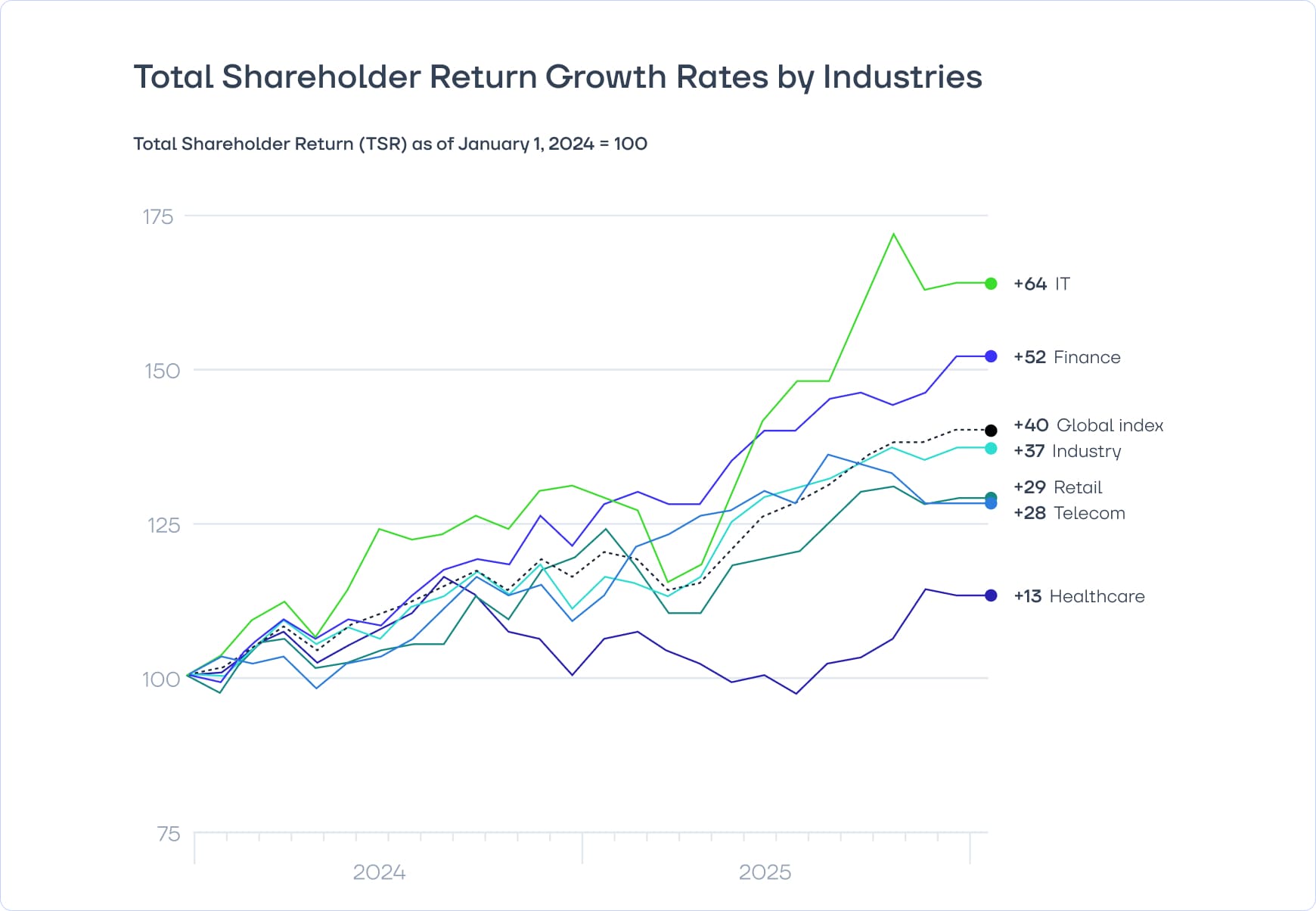
McKinsey highlights four strategic moves that can shape a successful future for telecom operators:
- Automating processes with artificial intelligence while eliminating data and infrastructure silos
- Expanding offerings through affordable add-on products and hyper-personalization
- Upgrading outdated systems and technologies
- Streamlining and consolidating assets
Operators that execute on these four priorities are expected to strengthen their financial performance. Those that fail to adapt will face even tougher competition.
These changes are reshaping how operators engage with customers, putting CVM (Customer Value Management) at the center. The success of CVM depends heavily on automation, which is only as strong as the underlying IT platform. Modern CVM solutions act as a unified hub for data, AI, and customer interactions. While most operators are moving in this direction, many still hit the limits of their existing infrastructure, and those limitations show up in several critical areas.
How to Know Your CVM System Is Not Delivering
The earliest warning signs show up in your metrics: campaign conversions drop, incremental revenue declines, and churn starts to rise.
Metrics are just the surface. The real problem runs deeper:
- Team: not enough skilled talent or expertise to drive CVM forward
- Processes: teams are not experimenting with new approaches or scenarios
- Strategy: lack of leadership support or a clear vision for CVM growth
- Technology: the platform no longer meets evolving business needs
Now let’s dive deeper into the last one.
Sign 1. No Single Customer Profile
Customer data is one of the biggest growth drivers for telecom operators. But when it is fragmented across CRM, billing, and DWH systems, and there is no unified data lake, teams end up manually piecing together each subscriber profile.
As a result:
- Data becomes inconsistent
- Customer profiles quickly lose relevance
- Campaigns are delayed
- Conversion rates underperform
Modern CVM platforms connect directly to data sources and power communications with a true 360° customer view. They factor in interests, social context, relationships, and other unique traits. With real-time automation, profiles stay up to date, so every offer is highly relevant.
Sign 2. No Real-Time Decisioning
When campaigns rely on schedules instead of real-time triggers, they cannot keep up with customer behavior. As a result, offers:
- Are pre-built in advance
- Miss the current context
- Are not updated at the moment of interaction
Modern CVM platforms run on event-driven communication, making decisions in the moment instead of in advance. This real-time approach boosts conversion and overall campaign performance.
Eastwind helped mobile operator Kcell boost offer conversion by 12% and increase revenue by 7% through personalization. This was achieved by developing Next Best Offer ML models and integrating them with the product catalog of the EW AdTarget campaign management platform.
Offers are now generated automatically based on ARPU, data usage, discount levels, and likelihood of activation. Before delivery, the system validates each offer against the subscriber’s current balance and recent activations to ensure relevance.
Sign 3. No Omnichannel Orchestration
When SMS, USSD, push, and digital channels operate in silos, messages overlap, conflict, and hurt the customer experience. Without centralized orchestration, companies cannot manage interactions as a single journey. The result is weaker personalization and lower ARPU.
Modern CVM platforms orchestrate customer interactions across SMS, USSD, IVR, push, web, and mobile apps to deliver a seamless experience. Built-in contact policies and preference management ensure every touchpoint is consistent, boosting personalization and driving higher conversion.
One of Eastwind’s clients boosted profit by 50% in just six months by personalizing communications and adding a new channel to its campaign manager. By focusing on a messaging platform popular with younger users, the operator achieved a 40% response rate.
Sign 4. No Automated ML Model Retraining
Machine learning drives automation and powers personalized offers. But without regular updates, ML models lose accuracy and their predictions become unreliable.
This happens when models fail to incorporate new product and customer data and rely on manual retraining. The update cycle slows down, and offers become outdated faster than customer behavior evolves.
Modern CVM platforms are powered by self-learning models that continuously optimize based on campaign performance, adapting to changes in customer behavior and product offerings in real time.
Eastwind uses an AutoML pipeline to continuously adapt models to change. This reduces operational overhead and keeps ML model recommendations accurate and up to date.
Sign 5. No Agentic AI in Place
Even with access to analytics and ML models, CVM teams often spend too much time on routine tasks such as audience analysis, segment selection, scenario design, content generation, and campaign evaluation. This leads to longer time-to-market and reduced agility. If conditions change after launch, flows must be manually adjusted.
Modern CVM platforms lighten the load on teams with AI agents. They handle repetitive tasks like segmentation, content creation, and journey design, while seamlessly working with ML models and other system components. The result is faster execution, more precise marketing, and lower costs.
Sign 6. No Clear Analytics
When reporting is manual, operators lose visibility and speed. They cannot:
- Track performance in real time
- Adjust scenarios quickly
- See the true impact of CVM on business results
As a result, marketing runs blind and cannot react in time. Changes are made only after the reporting period ends, when the opportunity is already gone.
Modern CVM platforms give real-time visibility into campaign performance and allow teams to optimize on the fly. With full automation, there is no need for manual data collection.
| Criteria | Legacy CVM | Modern CVM |
| How data is managed | • Data is fragmented across systems
• No unified view of the customer |
• A unified customer view powered by a data lake
• Real-time data updates |
| How decisions are made | • Campaigns rely on schedules
• Decisions are based on static segments |
• Decisions are made in real time, driven by customer behavior at the moment it happens |
| How communications are managed | • Channels are disconnected
• No single customer journey |
• Omnichannel orchestration
• A unified customer journey logic |
| How ML models are used | • Models are static
• Models need manual retraining |
• Automated retraining
• Continuous decision optimization |
| How routine tasks are handled | • Operations are manual
• Changes applied only after the fact |
• Automated segmentation, content generation, and flow creation powered by AI agents
• Ability to make changes in real time |
| How performance is measured and managed | • Reporting is delayed
• With no real-time visibility or control |
• Real-time insights and analytics
• Real-time optimization of campaigns and scenarios |
What a Modern CVM System Really Looks Like
Today, CVM is a platform that manages customer value across the entire lifecycle. Modern CVM platforms help:
- boost revenue by 5–8%
- increase upsell by up to 50%
- cut churn by up to 30%
Marketing automation shifts CVM teams away from manual execution and toward strategy and experimentation. It shortens time-to-market, increases agility, enables continuous testing, and helps teams find winning approaches faster with data.
How to Address an Outdated CVM Solution
If your current solution cannot keep up with market demands, there are two ways forward:
1. Upgrade your current platform if:
- It integrates with modern tools
- The vendor roadmap aligns with your strategy
- The investment in modernization makes sense
2. Replace the platform if it:
- Cannot integrate with ML tools or real-time platforms
- Does not support key digital channels like web, mobile apps, and social media
- Still relies heavily on manual work instead of full automation
Eastwind Marketing Platform (EW MP) helps transform customer value management without disrupting business operations. It provides a centralized hub for communications, with real-time performance tracking and the ability to optimize on the fly. By integrating the campaign manager with ML models, it speeds up execution, enables true hyper-personalization, and delivers more precise targeting.
Learn More About Eastwind’s CVM Platform


