

Kcell had already deployed big data infrastructure and subscriber profiles developed by Eastwind before the project. To fully realize the value of that data, automation was essential. We implemented machine learning models to improve prediction accuracy and increase offer conversion, integrating them seamlessly with the EW AdTarget campaign manager.

- Develop a suite of predictive ML models to drive revenue growth through hyper-personalized communications and improved subscriber retention.
- Integrate these ML models with the EW AdTarget campaign manager.
- Prepared the data and built a unified feature store.
- Configured feature store filters to train specific ML models.
- Developed five ML models.
- Integrated the models with the campaign manager.
7.3% is revenue uplift from campaigns powered by the Next Best Time model.
5% is revenue uplift from campaigns using the Next Best Offer model.
0.14% is conversion lift from campaigns driven by the Device Change model.
10.4% is reduction in customer churn after deploying the Churn Prediction model.
End-to-end ML model development and deployment services to boost sales, reduce churn, and deliver hyper-personalized communications.
Objective: boost marketing campaign conversion rates
When the project launched, Kcell was already using big data to drive Customer Value Management:
- data was aggregated in a Hadoop cluster;
- subscriber profiles developed by Eastwind were in place;
- an internal team of data specialists managed the process.
When launching campaigns, the operator’s team used subscriber profiles but relied on manually defined business rules for audience selection. This limited targeting accuracy and conversion rates. To fully unlock the value of big data, the customer set the following objectives:
- Drive campaign revenue by delivering highly relevant offers to each subscriber.
- Strengthen loyalty by engaging customers at the right time and through the right channel.
- Reduce churn by proactively reaching high-risk customers with timely, relevant offers.
- Boost device sales by targeting subscribers with outdated phones with tailored upgrade offers.
The operator did not have enough internal resources to execute the project. Instead of expanding the team, the customer chose a more cost-effective approach by bringing in Eastwind specialists. Our role was to develop predictive ML models and seamlessly integrate the results with the EW AdTarget campaign manager.
Speed to production was critical for the customer. We kicked off the project in October 2025 and, within just two months, deployed AutoML, an automated ML training technology. This allowed the models to go live immediately, with ongoing parameter tuning driven by real-world performance.
Explore best practices to predict and prevent churn, based on insights from Eastwind experts.
Get the e-bookSolution: develop and deploy 5 ML models within the CVM framework
When the project began, Kcell’s data infrastructure and unified subscriber profile were already fully integrated into the CVM system, allowing business users to seamlessly leverage them within the EW AdTarget campaign manager. This significantly ускорило delivery. We focused on building a feature store, enabling automated model retraining, and integrating the models. With the hardware already in place, implementation moved even faster.
Across every stage of development, we tracked and logged key metrics, enabling model comparison, parameter recovery, and seamless scaling when needed.
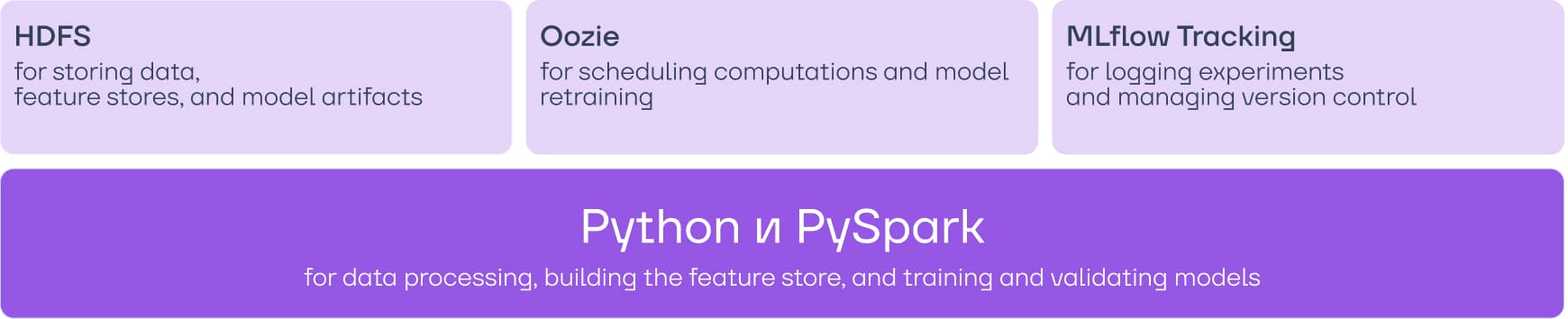
Building the feature store
Kcell was already leveraging subscriber profiles, which accelerated the project. However, we conducted a full audit of the existing feature stores, as the data structure had evolved over time, and consistent calculations are essential for accurate model training.
We built a unified feature store powering all ML models, bringing together:
- tariffs and services;
- usage patterns across voice, data, and messaging;
- financial data and payment history;
- device data and upgrade history;
- activity attributes;
- website interaction logs.
The feature store is automatically generated on a schedule and validated through built-in checks to ensure accurate, reliable predictions. For each model, we applied tailored filters to prevent errors and ensure consistent, stable results.
Automated retraining of ML models
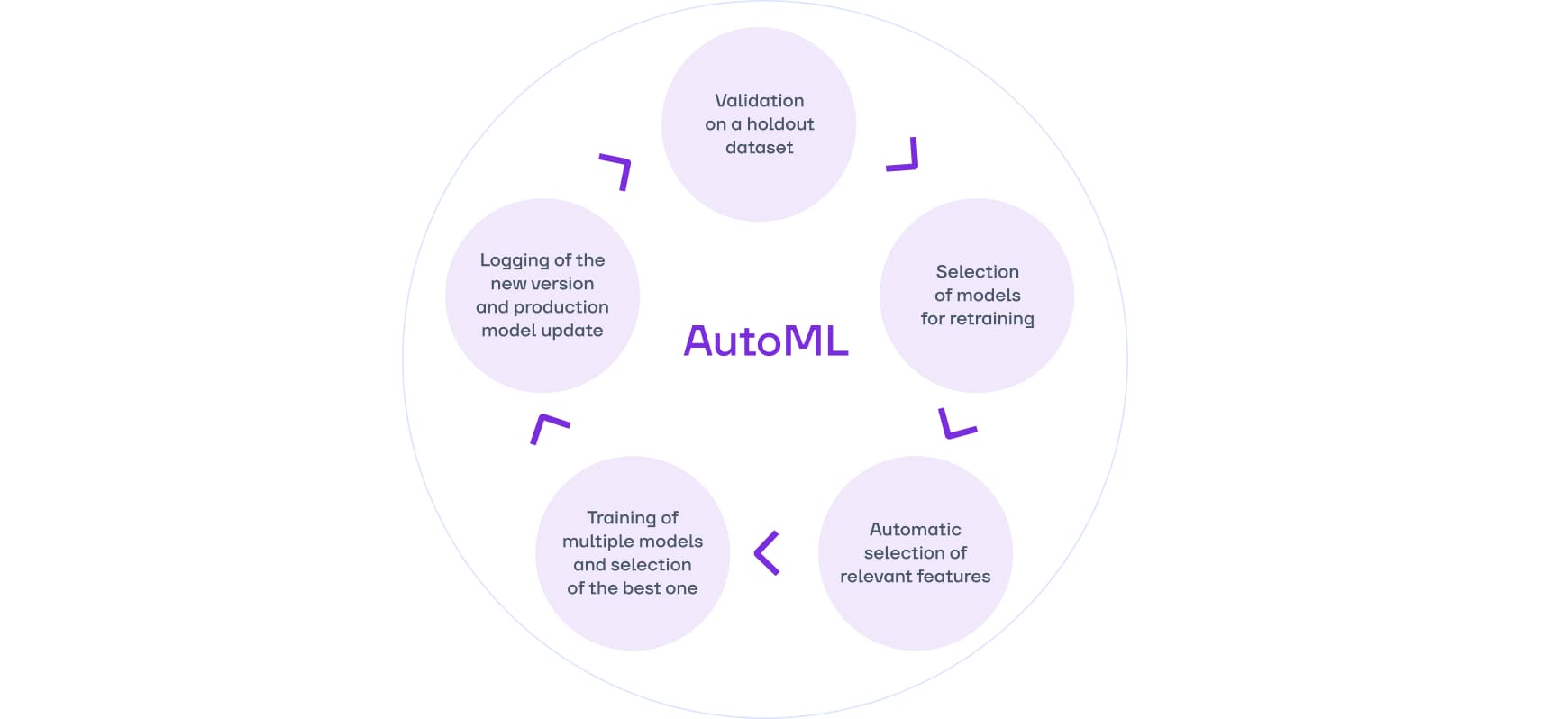
To keep models aligned with evolving subscriber behavior, we deployed an AutoML loop. Retraining is triggered:
- on a schedule;
- when sufficient new data is available;
- when performance metrics fall below defined thresholds.
AutoML enables models to automatically adapt to evolving subscriber behavior, reducing the workload on the operator’s team and allowing faster, more agile response to change.
ML model deployment
We developed five ML models and integrated them into the EW AdTarget campaign manager. The outputs are automatically pushed into subscriber profiles and used as actionable recommendations, while business rules remain fully managed by Kcell’s marketing team.
We evaluated ML model performance using the F1-score, which balances precision and recall. The metric ranges from 0 to 1, where 1 represents a perfect model.
| ML model | What it predicts | What it’s used for |
| Churn prediction | Subscriber churn based on inactivity | Proactive retention offers |
| NBO (up-sell) | The best tariff option | Upsell offers |
| Device Change | Likelihood of a new device purchase | Device upgrade offers |
| Next Best Channel | The most effective push channel for communication | Push channel selection |
| Next Best Time | The best time to deliver the offer | Message send time optimization |
Churn prediction
The model forecasts subscriber churn due to inactivity across three time horizons: 30 days, 7 days, and 1 day.
The model’s business objective is to reduce subscriber churn by identifying high-risk customers early and targeting them with relevant actions. This helps retain revenue and improve customer loyalty.
Inactivity is defined as no paid activity over 31 days, including:
- no balance top-ups
- no outgoing usage
- no data, voice, or messaging traffic
- no interconnect calls
- no tariff-related charges
| Prediction horizon | Precision | Recall |
| 1 day | 0.843 | 0.341 |
| 7 days | 0.707 | 0.824 |
| 30 days | 0.726 | 0.825 |
Next Best Offer
In this project, the ML model selects the best tariff from a predefined list provided by the customer. Each recommendation is based on four key factors: ARPU, usage volume, available discounts, and the likelihood of subscription.
The model’s business objective is to increase operator revenue by promoting higher-priced tariffs to highly active subscribers. This helps drive revenue growth and improve retention by expanding service usage.
To maximize targeting precision, the Eastwind team divided the models into two categories and developed dedicated models for each tariff:
- non-family: 11 models
- family: 7 models
While developing the NBO models, we discovered inconsistencies in how services were represented across the customer’s systems, which led to inaccurate recommendations. We standardized tariff representation and redesigned the reference data mapping logic, ensuring accurate, CVM-ready recommendations.
| Tariff plan | Precision | Recall |
| Plan 1 | 0.91 | 0.87 |
| Plan 2 | 0.84 | 0.80 |
| Plan 3 | 0.87 | 0.82 |
Device Change
The model predicts the likelihood of a subscriber purchasing a new device across two time horizons: 30 and 90 days.
The model’s business objective is to increase device sales by identifying users who are likely to upgrade. This helps improve offer conversion into device and related service sales.
To refine the target audience, we excluded non-phone devices such as tablets, smartwatches, and modems. We used the date when a device first appeared on the network as a key criterion, determined based on its IMEI identifier.
The analysis focused on three subscriber segments:
- active in the last 30 days
- connected to the network for over 90 days
- have not upgraded their device in the past six months
| Prediction horizon | Precision | Recall |
| 30 days | 0.91 | 0.87 |
| 90 days | 0.84 | 0.80 |
Next Best Channel
The ML model identifies the most effective push channel to engage each subscriber.
The model’s business objective is to increase positive response rates to interactions and improve offer conversion.
We analyzed subscriber responses across all communication channels within the EW AdTarget campaign manager:
- SMS with tailored logic for different campaign types;
- DSTK (Dynamic SIM Toolkit);
- voice bot interactions;
- mobile app push notifications.
| Channel | Precision | Recall |
| SMS | 0.715 | 0.815 |
| DSTK | 0.649 | 0.776 |
| Voice bot | 0.729 | 0.657 |
| Push | 0.692 | 0.674 |
Next Best Time
The model identifies the optimal time window to engage each subscriber.
The model’s business objective is to increase positive subscriber responses and enhance user experience.
For the analysis, we focused on subscribers who had been contacted within the last 30 days and whose responses were recorded in EW AdTarget. Since there was not enough data for hourly predictions, we defined three broader time intervals:
- morning: 9-11 am
- daytime: 12-5 pm
- evening: 6-8 pm
We then analyzed subscriber behavior across different days of the week, identifying key patterns and differences. As a result, the communication intervals remained similar in duration, but each was configured with its own tailored settings.
Weekdays:
- Mon–Fri: 9-12 am
- Mon–Fri: 12-6 pm
- Mon–Thu: 6-9 pm
- Friday: 6-9 pm
Weekends:
- morning: 9-12 am
- daytime: 12-6 pm
- Sat–Sun: 6-9 pm
The customer ran tests using the initial settings. When defining communication windows, we also accounted for regulatory constraints, allowing outreach to subscribers only between 9 am and 9 pm.
| Selected Time Frame | Precision | Recall |
| 9-11 am | 0.654 | 0.825 |
| 12-17 pm | 0.723 | 0.920 |
| 18-21 pm | 0.749 | 0.903 |
Result: 5 ML models in production within 1 month, delivering up to 7.3% revenue uplift
In the first stage, the customer prioritized developing and deploying ML models to evaluate initial performance. In the second stage, the models were fine-tuned based on A/B testing results.
Within just one month, the Eastwind team:
- built the feature store
- defined key model parameters
- trained the models
- launched them in AutoML mode
The operator then launched its first ML-driven campaigns and evaluated their performance. Testing was conducted on comparable subscriber groups:
- one group targeted using ML model recommendations.
- another based on expert-defined business rules.
For Churn Prediction testing, one group received model-driven offers, while the control group received no communication. For Device Change, performance was benchmarked against the client’s previously used ML model.
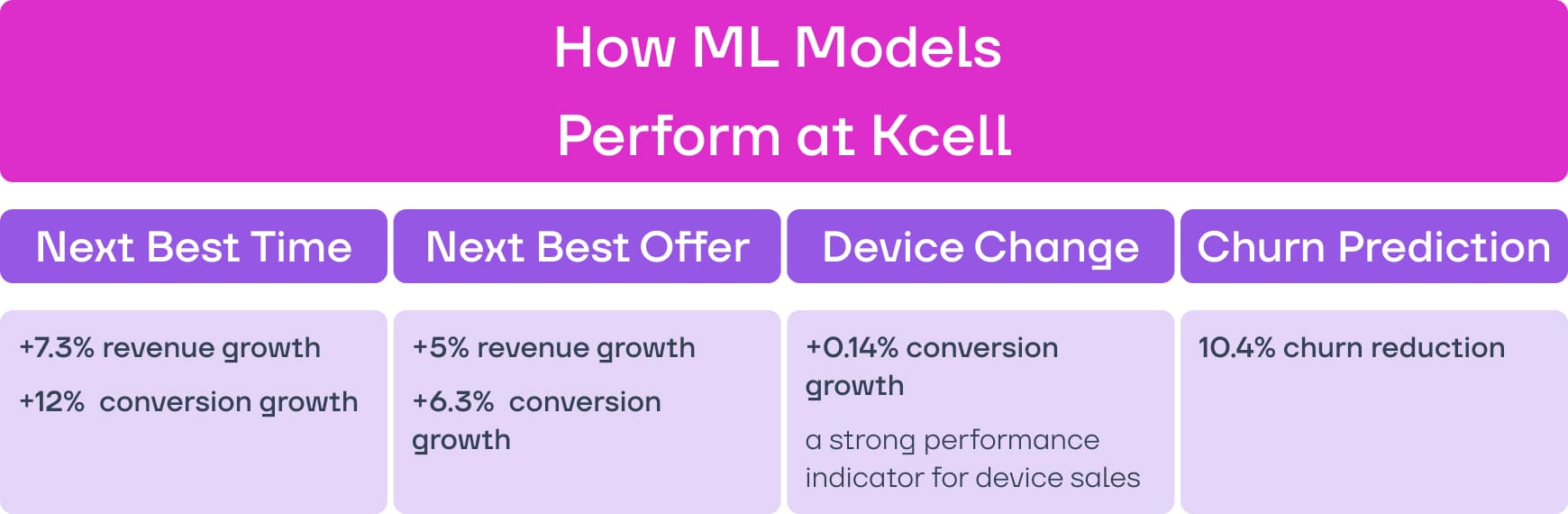
In the second stage, we expanded the communication channels by adding two voice bots, including an intelligent one capable of holding conversations and adapting tone and voice to each subscriber. We refined the feature store based on initial test results and further optimized the ML model hyperparameters.
Our goal for this predictive ML project was to deliver real business impact fast. The results with Eastwind exceeded expectations: in just one month, we launched five ML models in production, achieved a +7.3% revenue uplift, and reduced churn by 10.4%.

Kcell moved beyond standalone models to deploy a scalable ML infrastructure fully integrated with its existing CVM system. Continuous quality monitoring and retraining ensure consistently higher prediction accuracy.
Book a free consultation to start implementing ML models


