

When A2P traffic is routed through “gray” channels and bypasses proper billing, operators lose both revenue and subscriber trust in SMS. This article breaks down the key tools for protecting SMS traffic, explains how they differ, and shows why a fragmented set of systems is not enough to solve the problem end to end.
Learn how to evaluate your current SMS firewall or choose the right solution using five essential criteria.
Get the e-bookHow Fraud Impacts Operator Revenue and Reputation
Illegal A2P routes cause billions in losses. According to the Mobile Ecosystem Forum, “gray” routes were projected to cost mobile operators nearly $50 billion between 2018 and 2023, with about $7.9 billion in losses in 2021 alone. The same study found that 70% of respondents lost up to 10% of their annual A2P SMS revenue to fraud in 2020.
Subscriber trust is the other side of the problem. SMS was not built as a secure two-way channel, and users feel the impact directly: according to the U.S. Federal Trade Commission, consumers reported $470 million in losses in 2024 from scams that began with text messages.
For operators, this creates a double hit: lost A2P revenue and growing levels of spam and fraud that weaken trust in both the operator and SMS itself. Effective fraud prevention therefore supports two priorities at once: protecting users and monetizing traffic.

Fraud Prevention Tools on the Market and How They Differ
SMS traffic is exposed to many types of threats, so the market has evolved into several solution categories, each addressing a specific part of the problem.
Fraud Management Systems, FMS. These systems analyze operator network traffic and events to identify anomalies and fraud patterns. Their main strength is broad coverage across multiple fraud types, reinforced by historical investigation data. However, they often detect fraud after the traffic has already passed through the network, which means they cannot always block a fraudulent message at the moment of delivery.
ML Analytics and Data Monitoring. Operators are increasingly adding this class of tools to strengthen traffic filtering. According to the Mobile Ecosystem Forum, 37.5% of operators now see data analytics and monitoring as a key fraud detection measure, up from just 6.3% in 2019. Analytics is strong at uncovering new and evolving fraud schemes, but it does not control delivery on its own. It informs decisions rather than executing them.
Signaling Solutions. These tools protect the network at the signaling layer against attacks and manipulation in SS7 and Diameter protocols. According to the Mobile Ecosystem Forum, 45% of surveyed operators have deployed a signaling solution. But they are not built to manage the commercial side of A2P traffic, including message charging and routing.
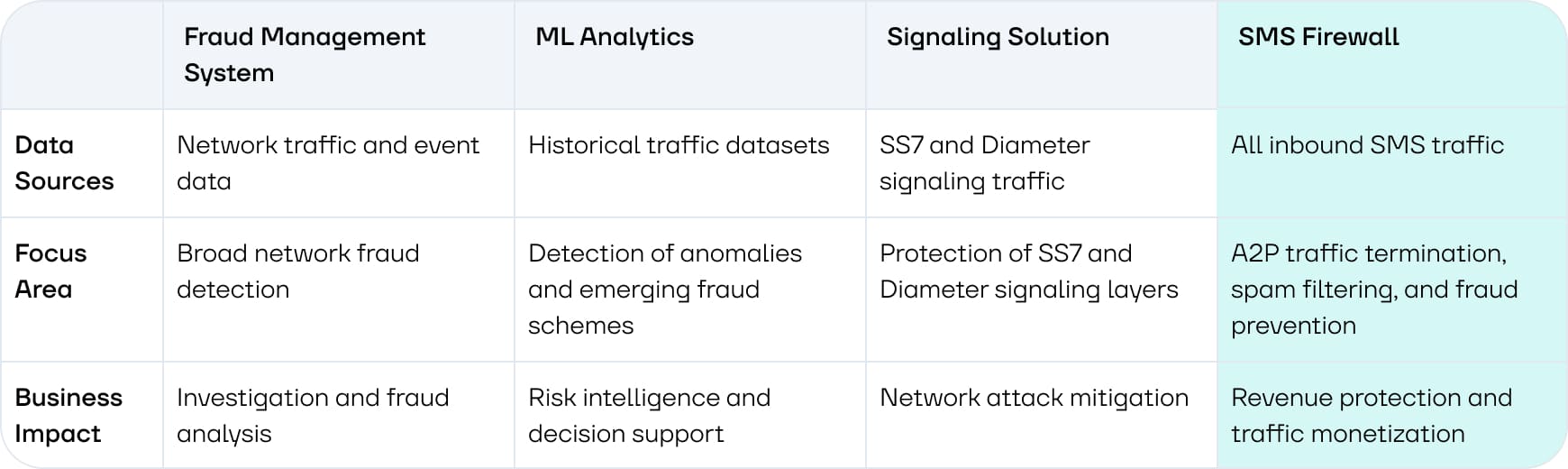
When these systems work in silos, operators run into the same problems:
- blocking decisions come too late, allowing some “gray” traffic to slip through undetected;
- traffic aggregation creates blind spots where no system owns the full picture;
- total cost of ownership (TCO) rises as operators have to maintain and integrate multiple systems;
- charging and routing remain disconnected from protection, leaving monetization in a separate domain.
This is exactly where the SMS firewall comes into play.
The market has evolved around several proven system categories: FMS and ML analytics provide deep data intelligence and anomaly detection, while signaling solutions secure SS7 and Diameter protocols. The next logical step for telecom infrastructure is to bring these capabilities together in a unified control layer.
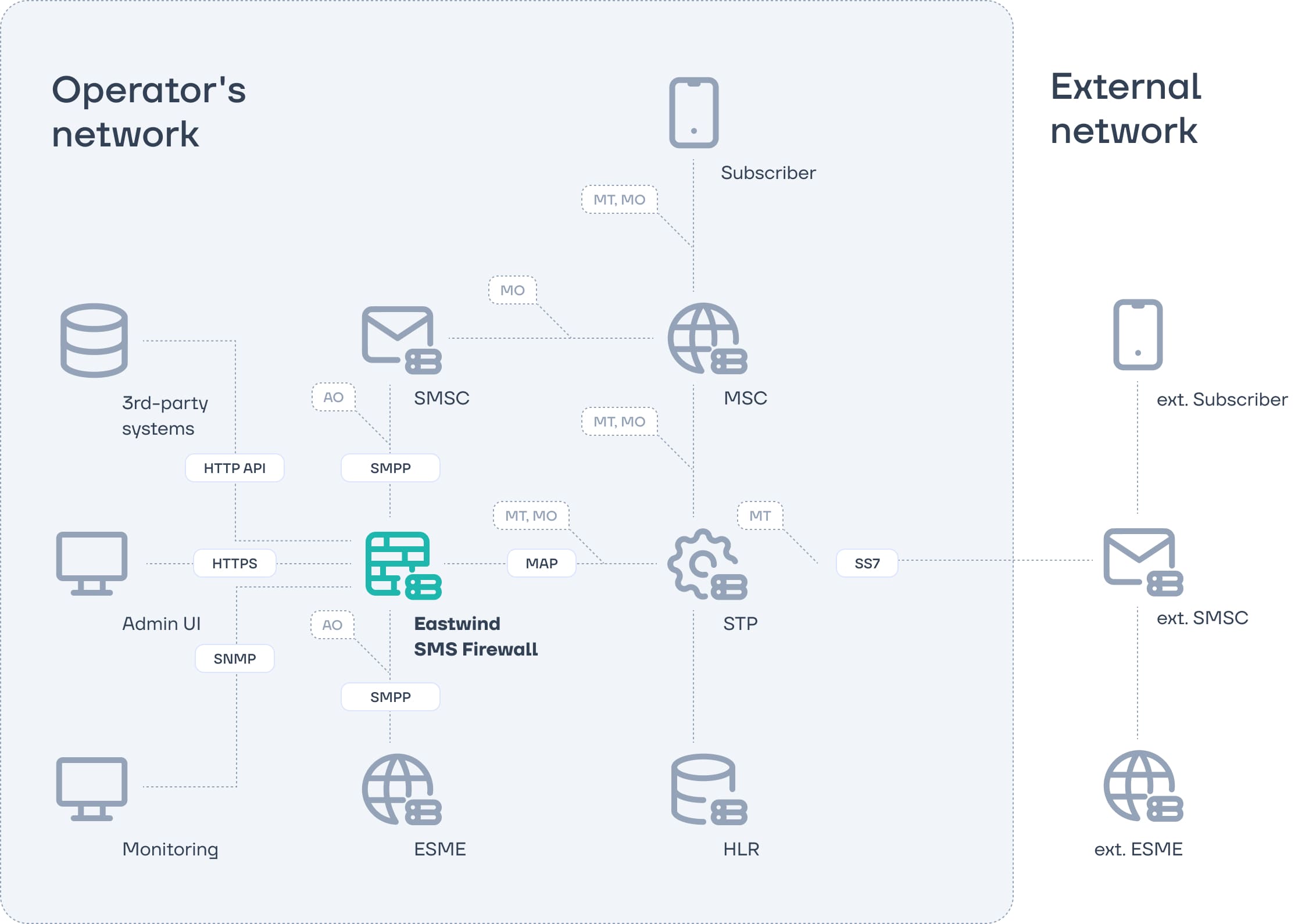
A comprehensive SMS firewall brings protection and monetization into one process. Sitting in the path of all SMS traffic, it ties each delivery verdict directly to charging and routing. This gives operators flexible control over commercial termination, enables real-time blocking of unauthorized messaging, and ensures accurate charging for legitimate A2P traffic.

How SMS Firewall Protects the Network and Revenue End to End
Unlike fragmented tools, the SMS firewall brings protection and monetization into a single process.
With one solution, operators can:
- detect and block “gray” routes and SIM boxes to recover A2P messaging revenue;
- monitor SMS campaigns in real time and stop unauthorized traffic without disrupting legitimate users;
- automatically build and maintain blacklists and whitelists for blocked and allowed senders;
- manage commercial termination terms directly by tying delivery decisions to charging and routing.
How to Choose the Right SMS Firewall for Your Infrastructure
An SMS firewall should be evaluated by what it can actually do: how fully it handles traffic, which fraud schemes it detects, how it manages charging, and how much support the vendor provides. A flexible, reliable solution is built on measurable capabilities, so they are worth checking before deployment.
Operators and SMS aggregators need different things from an SMS firewall. Operators are responsible for the network and traffic termination, so they need tight integration with signaling and billing systems, plus direct control over termination. Aggregators sit between senders and operators, so they prioritize traffic transparency, reporting, and delivery route management.
A practical evaluation can group the requirements into four areas: core capabilities, attack protection, A2P traffic monetization, and vendor support.
| What to Check | Why It Matters |
| Compliance with GSMA IR.70, GSMA AA.50, GSMA SG.22, and 3GPP TR 23.840 standards | The solution follows industry practices for SMS protection and filtering |
| Processing of all incoming traffic: MT (mobile terminated), MO (mobile originated), AO (application originated), and AT (application terminated) | No route remains outside control |
| Analysis of message content, volumes, sending times, and data packet types | Provides the basis for detecting anomalies and suspicious campaigns |
| Complex filtering rules with parameter combinations and active schedules | Enables flexible configuration for real traffic patterns |
| Convenient interface with dashboards, statistics, and analytics | The team can quickly see the full picture and respond |
| Export of CDR files for network events | Supports reconciliation with counterparties, stops revenue leakage, and provides control over inter-operator settlements for traffic termination |
| Scalability and API for managing rules from external systems | The solution grows with traffic and integrates into the infrastructure |
| What to Check | What It Protects Against |
| SMS spoofing detection | Roaming messages sent in the name of a home-region subscriber |
| SMS faking detection | SMS center address spoofing used to bypass delivery charges |
| SMS flooding protection | High-volume SMS attacks targeting a subscriber or system |
| GT scanning protection | Attempts to scan the operator network for vulnerabilities |
| URL phishing protection | SMS messages containing phishing links |
| Home routing | Exposure of subscriber data during delivery from external networks through fake IMSI generation |
| SMS spam protection | Bulk messaging that matches predefined filtering criteria |
| What to Check | Why It Matters |
| Traffic analysis by global title, SID, IMSI, and MSISDN | Delivers precise visibility into message origins and delivery paths |
| Correlation of SCCP with MAP GT and SID with GT | Reveals “gray” routing schemes |
| Content-based fraud detection using keywords, phrases, and message patterns | Separates legitimate traffic from unauthorized traffic without unnecessary blocking |
| Real-time detection of SIM boxes and A2P fraud using AI and ML | Identifies emerging fraud patterns that cannot be captured with static rules |
| Built-in A2P phrase libraries and preconfigured filtering rules | Allows the solution to start delivering results immediately after deployment |
| Customizable A2P reporting and analytics | Provides clear visibility into recovered revenue and monetization effectiveness |
The more requirements a solution covers, the better its chances of both protecting the network and recovering A2P messaging revenue. That is exactly what we designed EW SMS Firewall to do, with full traffic coverage, real-time detection, an ML core, and transparent monetization built in.
+183% Legal A2P Traffic in 6 Months After EW SMS Firewall Deployment
We helped an SMS aggregator operating on a Burundi operator’s network increase revenue from international A2P traffic termination by integrating its anti-fraud solution with Apache Kafka. The aggregator now processes 17,000 messages per day, creating an additional revenue stream.
What Operators Gain from Deploying Eastwind SMS Firewall
EW SMS Firewall combines international A2P traffic monetization with protection against spam and fraud. For operators and aggregators, it delivers three tangible business outcomes:
- greater transparency, with full visibility into network traffic and the portion that bypasses billing;
- stronger security, by blocking spam, fraudulent campaigns, and network attacks in real time;
- higher revenue, by shutting down “gray” routes and ensuring that A2P traffic is charged under established commercial terms.
The business impact of the last point is significant. According to Mobilesquared estimates, in networks without an SMS firewall, at least 80% of traffic travels through “gray” routes. Closing those routes is how operators recover lost revenue.
+50% Legal A2P Traffic in 9 Months After EW SMS Firewall Deployment
We helped an aggregator grow revenue from international A2P traffic termination by integrating its anti-fraud solution with Apache Kafka. The customer initially expected to process 40,000 A2P SMS messages per day, but nine months after integration, it beat the KPI by 50%. The aggregator now processes 60,000 messages per day, creating more revenue.
The biggest shift an SMS firewall creates is turning network protection from a cost center into a revenue driver. When traffic security and monetization are managed within a single control layer, fraud prevention begins to generate business value: the same mechanisms that block “gray” traffic also ensure accurate A2P charging.
EW SMS Firewall brings these capabilities together. Full traffic coverage, real-time detection, and an ML-powered core provide comprehensive protection, while transparent charging and termination control help operators recover lost revenue.
Explore the security and monetization capabilities of EW SMS Firewall


