

Most telecom operators rely on surveys to gauge subscriber loyalty, tracking metrics such as Net Promoter Score (NPS), likelihood to recommend the brand, and perceived service quality. While these metrics help measure customer sentiment, they do little to support revenue execution.
Knowing that a subscriber is satisfied does not reveal which offer they will respond to next or when they might start looking at competing providers. As long as customer sentiment and behavioral data remain disconnected, loyalty stays a qualitative indicator instead of a business growth tool. Customer Value Management (CVM) changes that by combining what subscribers think with how they actually behave, enabling operators to make data driven decisions that directly impact revenue.
The Three Pillars of Subscriber Loyalty
Subscriber loyalty rests on three core pillars:
- Trust: Customers know the company has their best interests in mind, delivers on its service commitments, and keeps their personal data secure.
- Customer experience: Every interaction feels simple and seamless. Processes are clear, offers are relevant, and support teams respond quickly.
- Engagement: Customers find brand communications valuable and are willing to act on them.
Yet telecom operators still face a wide gap between what subscribers expect and what they actually experience. According to Accenture’s 2025 data, 74% of consumers are frustrated by the lack of personalized support, 70% are unhappy with inconsistent service across channels, and 48% are frustrated when they must repeat themselves after moving to a new channel.
What Frustrates Telecom Subscribers Most
the lack of personalized support
an inconsistent experience across communication channels
having to repeat the same information after switching to another communication channel
For telecom operators, this is more than an abstract service quality problem. Each issue directly affects revenue: irrelevant offers do not convert, disconnected channels double the cost of customer engagement, and repeated interactions increase the burden on the contact center.
The Revenue Impact of Subscriber Loyalty
Subscriber loyalty translates into operator revenue through three core mechanisms.
- Retention. Churn costs far more than a single lost monthly payment. When a subscriber leaves, the operator loses the entire stream of future revenue from that customer. Retaining an existing subscriber is also almost always more cost effective than replacing them with a newly acquired one.
- Response. Relevant offers earn attention. Subscribers are more likely to respond, driving higher campaign conversion and incremental revenue from service and plan activations.
- Targeting accuracy. Better targeting means fewer customer contacts per conversion, lower campaign costs, and less promotional pressure across the subscriber base.
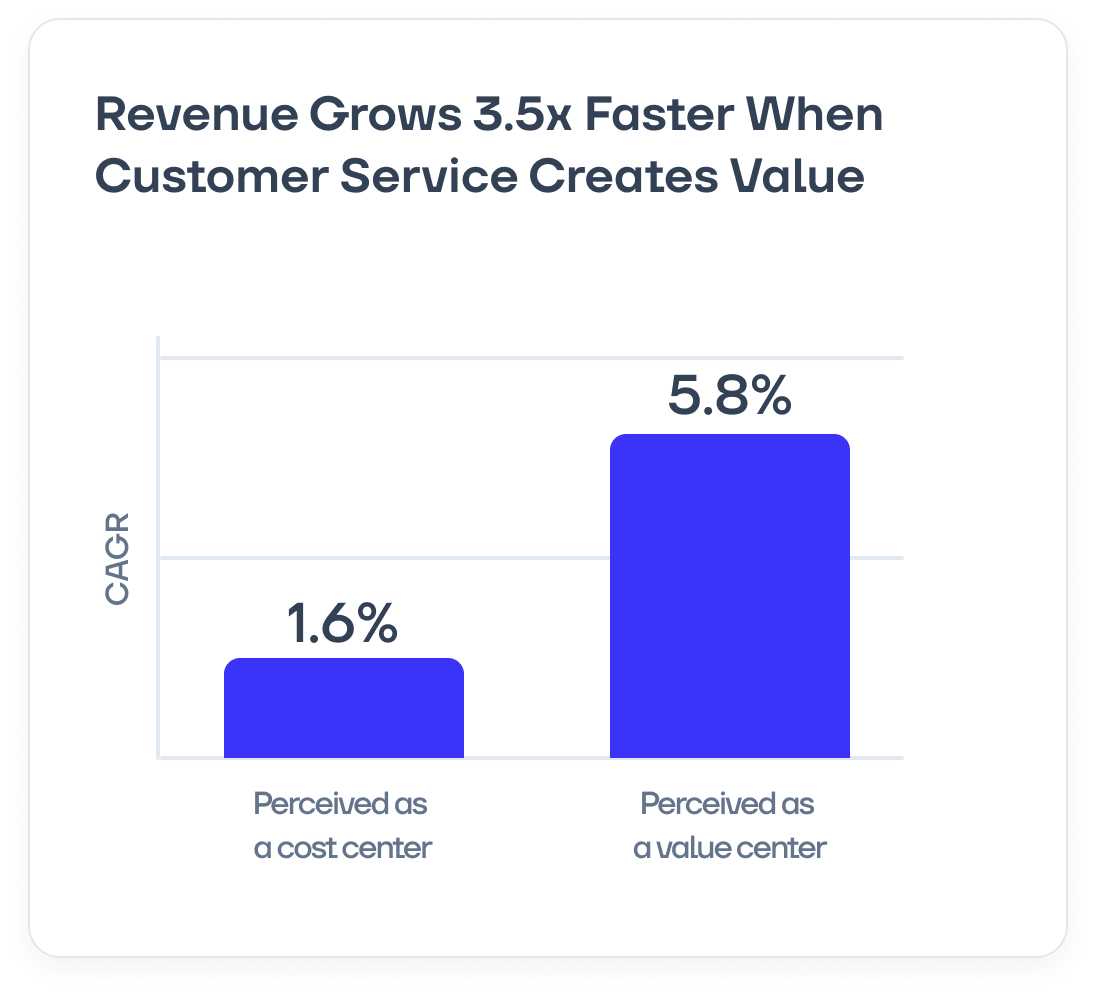
Industry research confirms the impact of these mechanisms. According to Accenture, companies that treat customer service as a “value center” rather than a “cost center” achieve 3.5 times higher revenue growth. Forrester reports comparable results: organizations with excellent customer service deliver 41% faster revenue growth, 49% faster profit growth, and 51% stronger customer retention.
To manage retention, response rates, and offer relevance, operators need a system that uses data to determine the right communication and immediately measures its financial impact. This is the role of a CVM platform.
Where Customer Loyalty Becomes Revenue: How CVM and ML Drive Decisions
A CVM platform helps operators answer four critical questions for every subscriber: who is at risk, what offer will work, when to engage, and which channel will be most effective. At the scale of millions of customers, those decisions cannot be made manually. Modern CVM solves this with predictive analytics, using a dedicated ML model for each decision.
1. Who to Retain: Stop Churn Before It Starts
Traditional retention campaigns begin too late. By the time a subscriber reduces usage, stops topping up, or requests to port their number, they have often already decided to leave. At that point, winning them back may be impossible or require an expensive incentive.
Churn Prediction models make retention proactive. They detect early behavioral signals and identify subscribers at risk before the decision to leave is final. Uplift models then determine who will actually respond to a retention offer and who would stay without a discount. This ensures that retention budgets are focused on customers whose behavior can still be influenced.
10.4% Lower Churn and 5 Production ML Models in Just One Month
Eastwind helped Kcell launch multiple analytical models for key business use cases and connect them directly to the campaign management platform.
2. What to Offer: Replace Mass Messaging With Personalization
Every irrelevant offer carries a cost. The more often subscribers receive messages that do not match their needs, the less likely they are to engage with future campaigns.
Next Best Offer and Product Affinity models solve this by identifying the product most likely to resonate with each subscriber. They weigh product interest, response probability, and expected business value using a unified customer profile that combines usage, transactions, support history, and past campaign behavior.
The way recommendations are executed matters just as much. In a mature CVM platform, the NBO model selects the product, while the product catalog automatically adds the right attributes, channel specific content, and activation journey. Instead of building a complex decision tree for every plan, the operator can use one campaign scenario across the entire product portfolio.
5% More Revenue From Next Best Offer Campaigns
Kcell’s systems described the same services in different ways, making consistent model training difficult. Eastwind unified the reference data, created a single feature store, trained models for specific plans, and launched them in production with automated retraining.
3. When to Reach Out: Timing Changes the Outcome
Offers lose relevance faster than traditional campaign planning often assumes. Sending an offer to buy additional data when a subscriber still has 10% of their package left can backfire, prompting them to conserve usage rather than make a purchase. Sending the same offer a day after the package runs out may also be too late because the subscriber may already have connected to Wi-Fi or switched to another SIM card.
A CVM platform therefore needs to respond to real-time events, such as package depletion, balance changes, roaming activation, or a device change. The Next Best Time model determines the optimal moment, and the campaign manager triggers the communication. It uses data from an online customer profile that updates the moment the subscriber takes an action.
7.3% Increase in Revenue From Campaigns Using Next Best Time
Kcell’s model identifies the time window when each subscriber is most likely to respond. It uses historical response data by channel, applies different intervals for weekdays and weekends, and accounts for the regulatory requirement that communications take place only between 9:00 a.m. and 9:00 p.m.
4. Which Channel to Use: Protect Revenue Without Overwhelming Subscribers
When USSD, SMS, push notifications, messaging apps, and the mobile app operate as separate channels, subscribers receive conflicting messages and excessive outreach at the wrong time.
Next Best Channel models identify where each subscriber is most likely to engage. Contact policies then control how often messages are sent, which channels take priority, and how much time must pass before the next interaction. The rules vary by campaign type because retention, win back, upsell, cross sell, and service communications all require different treatment. Instead of relying on manual checks during campaign approval, the platform applies these policies automatically before every message.
Each of the four decisions can improve results by several percentage points. Together, they transform how the operator works with its customer base. Campaigns become a connected conversation in which every interaction reflects what came before. That continuity builds the trust and engagement that drive subscriber loyalty and, ultimately, operator revenue.
What Keeps Loyalty From Translating Into Revenue
Analytical models do not generate revenue by themselves. They produce recommendations, and financial impact appears only when those recommendations are embedded into live campaigns. This handoff is where many projects fail: only 32% of analytical models reach production, while the rest remain stuck in pilot mode.
The same barriers appear repeatedly:
- Expertise gaps. Building a model and operating it in production require different skills. Data scientists need MLOps, DevOps, and data engineering support. Without it, a model may perform well in testing but fail to deliver business value in a live environment.
- Limited customization. Standard vendor solutions rarely reflect the specific data structures and product portfolio of a particular operator. This leads to generic recommendations and lower than expected accuracy.
- Lack of transparency. When a model behaves like a black box, marketing teams cannot understand how recommendations are generated and are less likely to trust them. As a result, decisions remain manual and campaigns stay unpersonalized.
The outcome is the same in all three cases: projects spend months in pilot mode, models lose accuracy without regular retraining, and internal data teams become a cost burden rather than a source of value.
Eastwind turns models into production ready solutions tailored to each customer’s business needs, with deployment completed in just a few months. Its AutoML pipeline automatically retrains models when new data arrives, performance drops, or a scheduled cycle begins. This keeps every model current without manual intervention and extends its production lifecycle beyond one year.
Sometimes analytical models are not the issue. Even a highly accurate model with timely retraining will fail to deliver business impact if CVM operates without a clear strategy, the team lacks capacity to develop new scenarios, or the platform cannot support triggered communications.
The barriers that prevent CVM initiatives from achieving their expected results typically fall into four categories:
- CVM’s role in the organization. Does the company have a CVM strategy with measurable objectives? Does it track CVM’s contribution to overall revenue? Do team KPIs cover retention, loyalty, and LTV, rather than focusing only on sales? When CVM is viewed as an operational support function, securing investment for its development becomes difficult. Global benchmarks indicate that CVM can increase ARPU by 5% to 10%, providing a compelling business case for senior leadership.
- Operating model. Is CVM organized as an independent function? Does the team have sufficient resources and decision making autonomy? Does the company invest in professional development? The level of routine work also matters: greater automation gives the team more time to focus on strategic priorities.
- Platform capabilities. Marketers should be able to create complex segments and launch campaigns without relying on technical teams. The platform should provide a real time unified customer profile, behavior based offer personalization, triggered journeys, omnichannel orchestration, contact policies, and built in analytics for rapid performance evaluation.
- Innovation and continuous development. Is there a defined CVM roadmap? Does the team regularly test new personalization methods? Is there enough capacity for experimentation? Without ongoing development, CVM initiatives plateau and competitors gain an advantage.
Calculate your score, identify your current CVM maturity level, and get practical recommendations for moving forward.
Download the checklistHow to Begin the Shift to Managed Customer Loyalty
These challenges cannot be solved one at a time. In most organizations, progress happens across multiple areas simultaneously. Even so, successful projects typically follow the same sequence:
1. Identify where revenue is leaking. Determine whether the primary issue is churn, poor campaign conversion, or unrealized customer value. At this stage, operators prioritize use cases and establish measurable KPIs, including response rate, conversion, retention, and revenue. Business goals drive the technical requirements, which then determine the ML models and data required.
2. Create a reliable data foundation. Integrate data from multiple sources, establish centralized storage, build a unified subscriber profile, and, for real time use cases, maintain an online profile that updates whenever the customer takes action. Without complete and current customer data, even accurate models lack the context needed to deliver relevant recommendations.
3. Integrate Models With Campaign Execution. Model recommendations should feed directly into the campaign manager and automatically trigger communications across connected channels, without teams manually moving audience lists between systems. The platform can then decide who should receive which offer, at what time, and through which channel, and execute the decision immediately.
4. Measure Results and Preserve Performance Over Time. Control groups in every campaign reveal how much of the outcome was created by the communication itself. That incremental difference represents CVM’s contribution to revenue. Campaign analytics support rapid scenario optimization, while automated retraining keeps predictions accurate as subscriber behavior and the product portfolio evolve.
Loyalty remains an abstract metric until it is translated into concrete decisions: whom to retain, what to offer, when to engage, and which channel to use. When these decisions are data driven and executed automatically, loyalty becomes measurable in retained subscribers, campaign conversion, and incremental revenue.
The right implementation path depends on the operator’s current CVM maturity and data readiness. A consultation with our experts can help assess the starting point and show how Eastwind Marketing Platform can support specific business objectives.
Discover the Eastwind CVM Platform


