

Over the past decade, the telecom market has undergone significant transformation. Traditional marketing in telecom encounters problems. Retaining customers and achieving business goals is becoming increasingly difficult. In this article, we explore why telecom marketing fails and what strategies companies should adopt instead. At the end, you’ll find a self-assessment checklist to help you evaluate how well your current CVM solution meets the industry demands 2026.
How the Telecom Market Has Changed Over the Past 10 Years
With the rapid advancement of technology, the mobile communications market has reached a saturation point. Profit growth and ROI have slowed. Let’s take a look at how this shift is affecting the business landscape—and how telecom marketing has evolved by 2026 as a result.
Declining Profitability and Intense Competition
A decade ago, mobile operators were seeing annual revenue increase of 10–20% simply by expanding their subscriber base. By 2026, however, things look very different. According to McKinsey, marketing efficiency in the telecom industry is on the decline. An annual revenue growth across global telecom operators has been steadily decreasing and now hovers around just 2%.
Another major issue: operators are pouring massive investments into network infrastructure and 5G development, but these costs are barely recouped. Fierce market competition and strict regulatory limits prevent companies from raising prices to even minimally profitable levels. As a result, telecom marketing is facing problems with ROI.
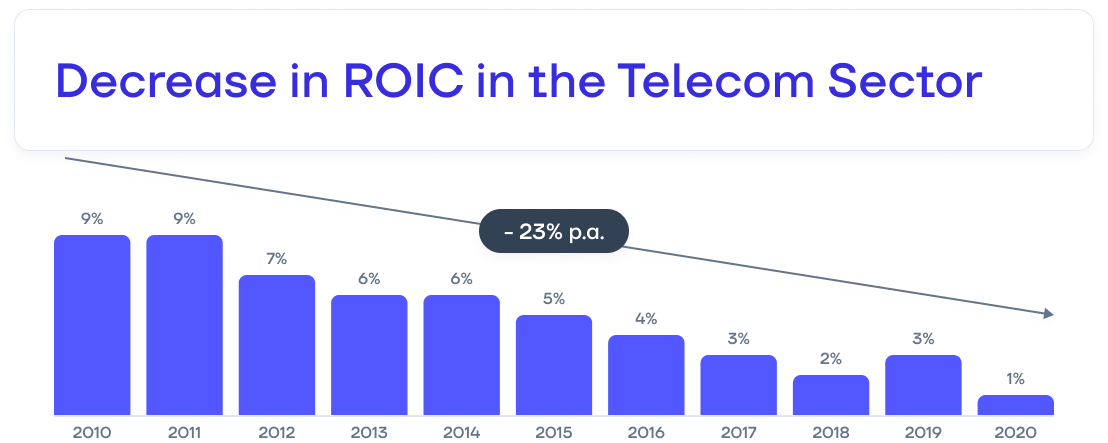
The inability to raise service prices due to competition and regulatory constraints is only one factor behind the telecom industry’s declining performance. The second—and equally critical—is the decreasing effectiveness and the traditional telco marketing strategy crisis. Why is this happening, and how can operators find new ways to retain customers and boost revenue? Let’s explore.
The Telecom Marketing Crisis 2026: Why Customers Are Leaving and ARPU Isn’t Growing
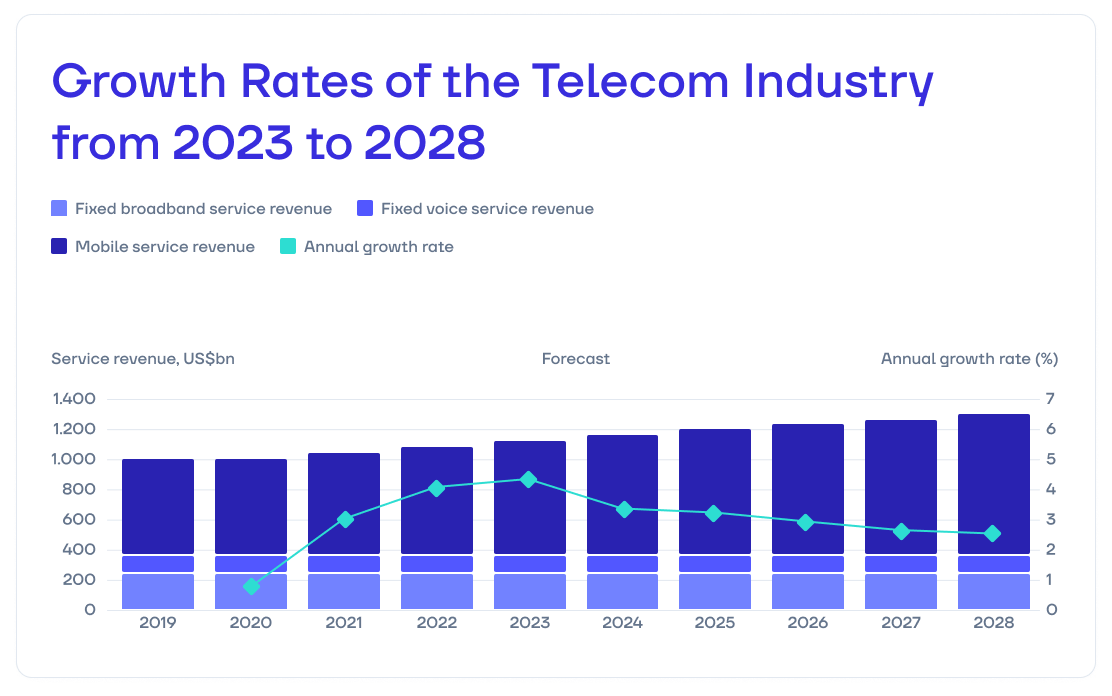
The telecom services market faces saturation problems, making it increasingly difficult to attract new subscribers. In response, operators have shifted their focus to boosting ARPU (Average Revenue Per User). But even these efforts are falling short. In developed countries, ARPU is already on the decline and, according to PwC, is projected to keep dropping at an average annual rate of –1.3% through at least 2028.
Since 2023, the overall growth rate of the industry has also been slowing alongside ARPU. The result is that business models that once reliably generated revenue are no longer delivering.
One of the key reasons for declining revenue is outdated customer communication strategies, in particular mass marketing inefficiency in telecom. For years, marketers relied on mass messaging and campaigns based on basic manual analysis of the subscriber base or customer surveys. By 2026, traditional campaign effectiveness declined: non-personalized offers not only fail to drive purchases—they actively frustrate subscribers. Receiving irrelevant promotions is now one of the top two drivers of customer churn.
Today, telecom customer behavior is changing. Users expect a personalized experience. The reason is simple: they’re getting similar services from multiple operators, so their choice is no longer based on price alone—it’s also about the quality of service. If the customer experience falls short of expectations, switching providers is easy. Subscriber churn has become a significant challenge in telecom marketing.
Yet retaining an existing customer is 25 times more cost-effective than acquiring a new one (CAC), and it delivers greater long-term value by increasing LTV.
To stay competitive, operators need to fundamentally rethink how they communicate with their audience. A higher level of service is impossible without personalization—it’s essential to take into account each subscriber’s behavior, interests, and context. Customer engagement challenges are emerging for telecom.
But with millions of users, manual data handling simply isn’t feasible. That’s why traditional tools are being replaced by automated platforms that enable real-time audience segmentation and personalized, omnichannel communication at scale.
Find out which three capabilities of a modern campaign manager help increase revenue
Get the e-bookThe Marketing Automation Issues in Telecommunications
By 2026, the primary tool for telecom marketing automation is the campaign manager. It frees operator teams from routine tasks, accelerates workflows, and enables them to:
- Precisely segment target audiences
- Flexibly manage contact policies
- Respond quickly to shifting customer needs
- Launch more campaigns simultaneously—and do it faster
- Test hypotheses and rapidly scale what works
But a campaign manager is just one piece of effective marketing. To make a real impact on incremental revenue, ARPU and LTV operators must analyze customer data and respond to user actions and events. This is where analytics and trigger platforms come into play:
- A trigger platform allows for real-time audience segmentation and helps identify the optimal moment to launch a campaign
- An analytics platform builds 360° subscriber profiles and predicts behavior, enabling a deeper understanding of the audience and more relevant offers
All three areas of marketing automation are covered by the EW Marketing Platform CVM solution. It creates a synergistic effect by centralizing data processing and automatically feeding insights into other systems for marketing use. As a result, staff workload and time costs are reduced, while targeting accuracy and campaign conversion rates significantly increase.
We’ve seen the telecom market evolve first hand over the past few years. A decade ago, CVM solutions seemed like a luxury reserved for major players—but today, marketing automation is essential.
Consumers have become much more demanding when it comes to service. They expect operators not just to meet their needs, but to anticipate them. That’s where a comprehensive CVM solution comes in. It enables businesses to truly understand their audience, predict behavior, and stay one step ahead of customer expectations.
This approach helps companies boost subscriber loyalty and ARPU, reduce churn, and ultimately grow their incremental revenue.

How to Solve Telecom Marketing Challenges in 2026
New challenges call for new solutions. Let’s look at how the transformation trends are reshaping telecom marketing and how automation through a CVM platform helps telecom operators address today’s business demands.
Problem: Manual Processes Hold Campaigns Back. Keeping up with changing subscriber behavior requires operators to continuously analyze performance and optimize campaigns in real time. Manual workflows make that difficult: they are slow, resource-intensive, and vulnerable to errors. Even a routine campaign launch can involve multiple handoffs. A BI analyst manually builds the target audience and prepares reports before passing them to the marketer. The marketer then pulls campaign reports, reviews performance, adjusts messaging parameters, and sends offers to the selected audience. The result is a process that takes valuable resources away from strategic work and limits how quickly teams can respond to campaign results.
Solution: Automate Campaign Management. Automation removes routine work from the campaign lifecycle, reduces the risk of errors, and allows teams to launch new activities in minutes. In EW AdTarget, reports are generated automatically, key metrics are available on dashboards, and messaging parameters can be adjusted in just a few clicks. Ready-made templates and a no-code builder make it easy for marketers to launch and optimize campaigns quickly. In 2026, automation is the defining trend in telecom marketing.
The future of telcos: Mapping the routes to renewed success (McKinsey)
of executives rank automation as the top method for improving efficiency
Discover what Eastwind’s campaign manager can do

Problem: Surface-Level Segmentation Cannot Capture the Full Subscriber Picture. The data collected when a subscriber purchases a SIM card tells only part of the story. It does not reveal social connections, frequently visited websites, geolocation patterns, services used, or even the actual SIM card owner. Without these behavioral insights, operators are left with incomplete subscriber profiles and miss opportunities to grow ARPU by promoting services that are truly relevant.
Solution: Create a 360° View of Each Subscriber. By combining behavioral data from multiple sources, operators can build ML models that predict customer behavior and create detailed 360° subscriber profiles. Eastwind deploys these analytical models directly within the customer’s infrastructure, enabling advanced subscriber profiling and churn prediction.
Real-Time Analytics (Harvard Business Review)
of executives reported an increase in customer loyalty as a result of using data analytics
We build the data infrastructure, develop the models, and bring them into production
Problem: Even a Relevant Offer Can Fail if the Timing Is Wrong. Personalized offers convert best when they reach subscribers at the exact moment a need arises. For example, a subscriber who has just run out of mobile data and has enough funds in their account is far more likely to purchase a one-time data package than they would be at any other time.
Solution: Trigger Offers at the Right Moment. Platforms such as EW Event Processing continuously monitor subscriber events and identify the best time to act. If a subscriber runs out of data while having sufficient funds available, the system automatically sends a signal to the campaign manager to offer an additional data package.
Real-Time Analytics (Harvard Business Review)
of executives believe that real-time marketing is critically important for improving customer experience
Trigger platform that drives marketing conversions
Problem: Fragmented Data and Disconnected Channels Undermine Personalization. Customer information is often scattered across multiple systems, while communication channels operate in silos.
- Service usage lives in billing systems, interaction history in CRM, and app activity in web analytics platforms. Without a unified data layer, operators cannot build a complete view of each customer or accurately understand their needs.
- SMS campaigns, push notifications, and in-app banners are often managed independently. This can lead to duplicate or conflicting offers across channels, creating an inconsistent customer experience and reducing response rates.
Solution: Unify Data, Intelligence, and Communications. EW Marketing Platform brings subscriber data, AI analytics, and communication channels together in a single environment. It consolidates data from all sources into a real-time 360° customer profile. ML models, including churn prediction, NBO, and others, analyze customer behavior and identify the most relevant personalized offer. EW AdTarget then uses these predictions to target each subscriber and select the optimal communication channel.
The Mobile Economy 2024, GSMA
operational costs can be reduced when implementing AI in marketing
330,000 New Music Service Subscribers in Six Months
A mobile operator in Central Asia deployed the full EW Marketing Platform stack to promote its music service. Using analytical models, the operator segmented the audience, set up real-time triggers in EW Event Processing, and launched the campaign through EW AdTarget. The result was a 40% response rate to USSD messages and engagement from 5% of the operator’s entire subscriber base.
Find out how the EW Marketing Platform can solve your business challenges
Key Telecom Marketing Transformation Trends in 2026
In the face of fierce competition, ad fatigue, and low customer loyalty, traditional marketing tools are no longer up to the task in 2026. Generic SMS messages sent at the wrong time are, at best, ignored—and at worst, frustrate subscribers and drive them toward more customer-centric competitors.
To remain competitive, telecom operators must transform their marketing processes. This transformation begins with a clear understanding of where things stand today: What’s missing? What’s holding back performance? And what can be done to fix it?
We’ve put together a checklist to help you self-assess your current marketing tools and see how well they align with the demands of the modern telecom market.
The questions below will help you determine whether your current marketing tools align with industry trends. If you leave more than half the boxes unchecked, it may be time to rethink your approach—your existing system might not be keeping pace with today’s market demands.
| Target Audience | Campaign Effectiveness | Campaign Management |
| Do you know the following about your subscribers: • the actual gender and age (not from a registration form) • network of contacts • interests (websites visited, call activity) • geolocation and frequently visited places • preferred communication channels • level of satisfaction with services |
Do you evaluate: • the number of opened marketing messages • the campaign conversion rate • the campaign ROI (Return on Investment) • the most effective communication channels • the difference in ARPU between the target group and the control group |
How convenient and flexible are your processes: • you can launch a campaign in just a few minutes • you can adjust the parameters of ongoing campaigns • a single marketer can manage multiple campaigns simultaneously • campaign management doesn’t require specialized technical skills from the marketer |
Book a free platform demo

